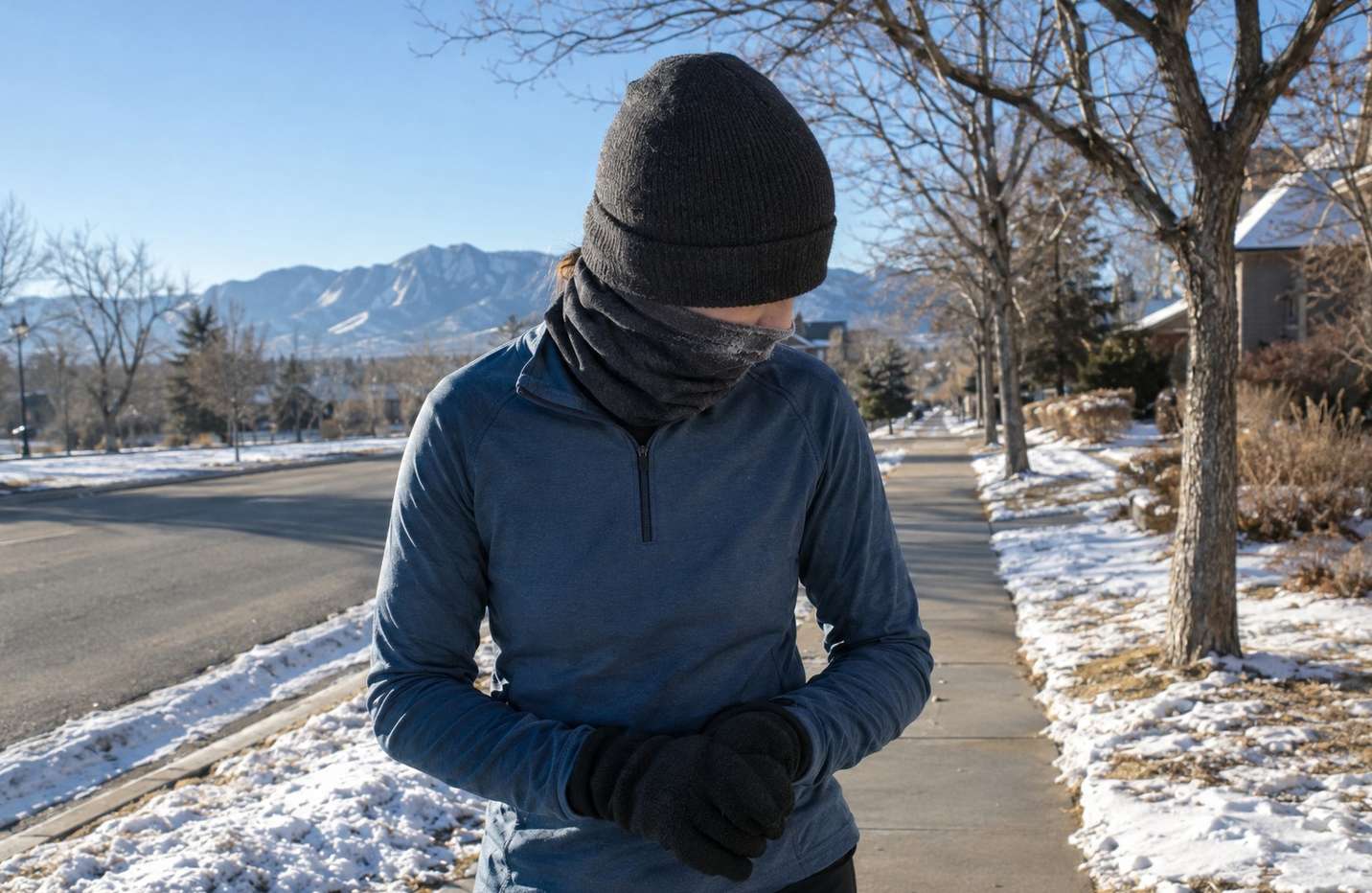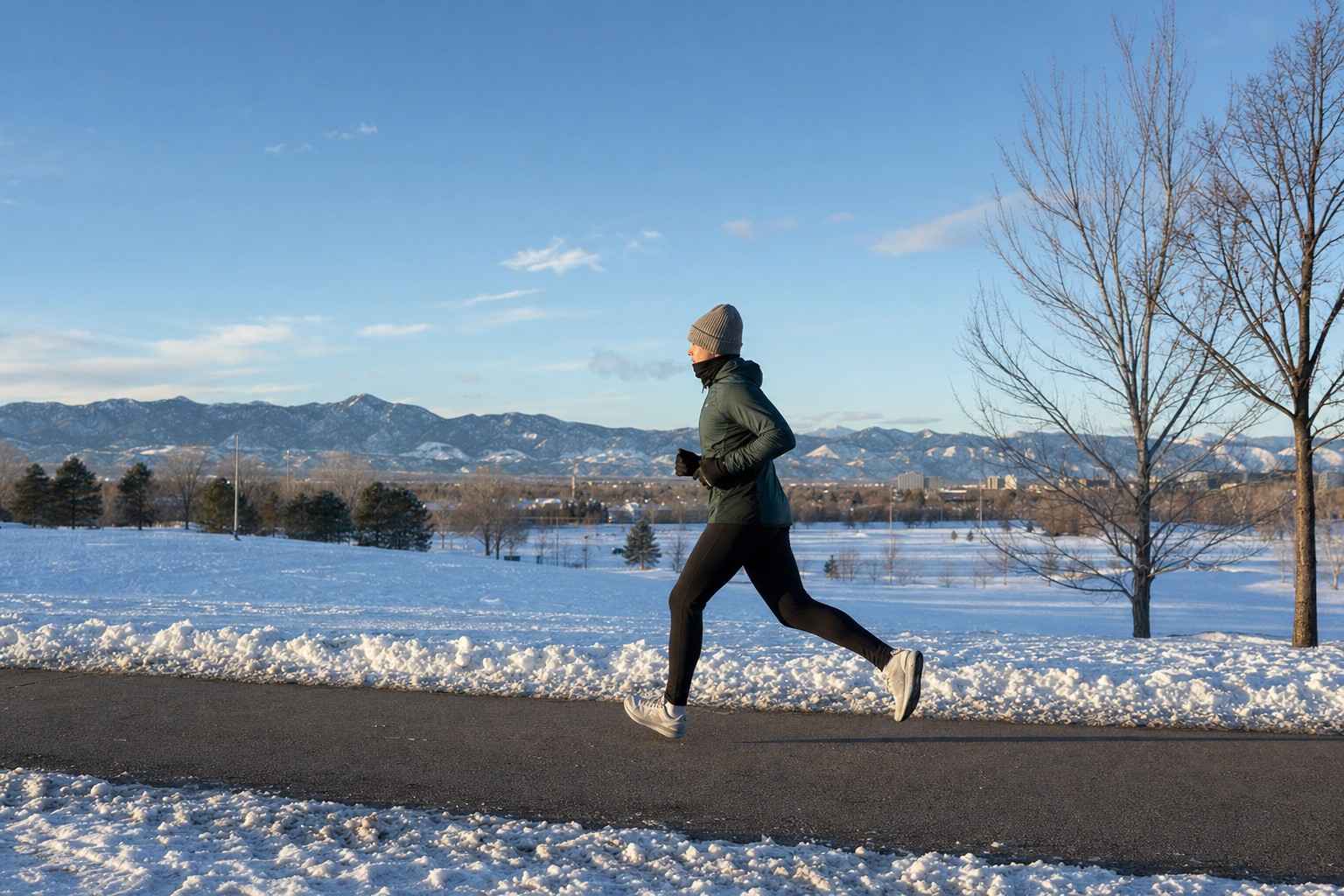
On a February run across fresh snow, as much as 80 percent of the sun’s ultraviolet comes back up at you.
Ultraviolet, the UV in every forecast, is the part of sunlight that burns skin. That 80 percent figure comes from the World Health Organization.
The altitude effect is real, and it is the smallest part of this story.
The altitude warning is standard in Colorado outdoor writing. It’s true, and it’s smaller than it sounds. The bigger change sits under your shoes.
What a mile of altitude actually adds
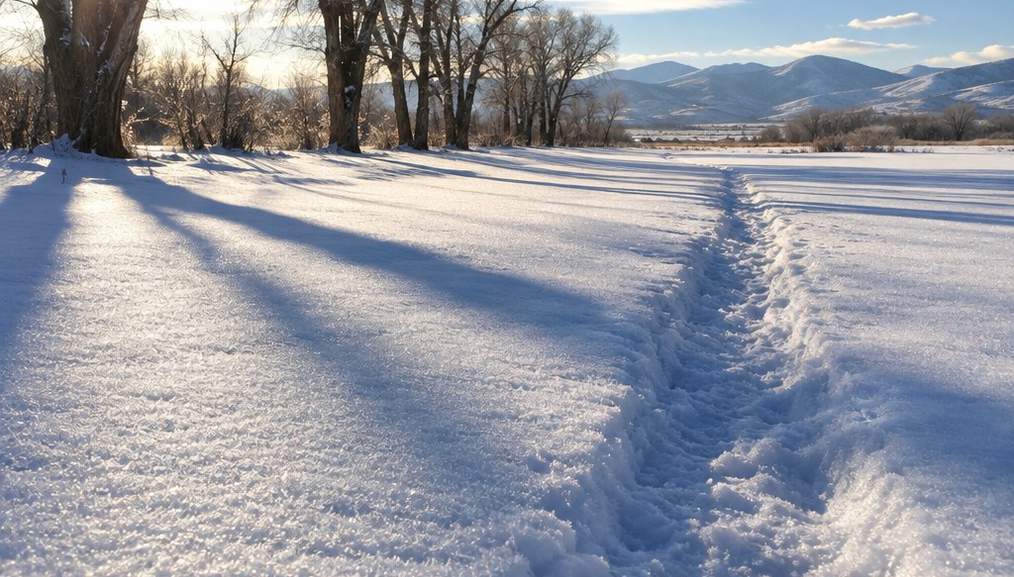
The warning usually arrives without a number. The numbers exist, and there are two of them.
UV levels rise roughly 10 percent for every 1,000 meters of altitude. That figure comes from the World Health Organization.
The National Oceanic and Atmospheric Administration (NOAA) runs the Climate Prediction Center, which computes the daily U.S. UV Index forecast. Its model uses about 6 percent per kilometer, according to its published method.
Same units, different numbers. Denver sits at 5,280 feet, which is 1,609 meters.
Apply the WHO figure and you get 16 percent. Apply NOAA’s and you get 10 percent.
Neither body prints that range. It’s arithmetic on their published figures: roughly 10 to 16 percent more UV than the same run at sea level.
That’s a real penalty, and a modest one. The bigger effect shows up in February.
The forecast already includes it
The runner’s job is simpler than that arithmetic, because the UV Index already did it. The index is the daily sun-strength number on every weather app.
It comes from a model run by NOAA’s Climate Prediction Center. The inputs include forecast ozone, cloud amounts, time of day, day of year, latitude, and elevation. Aerosols, tiny particles in the air, can subtract up to 20 percent.
Elevation is one of the inputs. A UV Index of 9 in Denver is already a Denver 9, and adding a mental altitude adjustment on top counts the altitude twice.
The method page even shows its arithmetic, dividing the computed dose rate by 25 milliwatts per square meter to get the index.
The Environmental Protection Agency’s UV Index scale puts each band in plain words:
- 1 to 2, Low. “No protection needed. You can safely stay outside using minimal sun protection.”
- 3 to 7, Moderate to High. “Protection needed. Seek shade during late morning through mid-afternoon.”
- 8 and above, Very High to Extreme. “Extra protection needed. Be careful outside, especially during late morning through mid-afternoon.”
The UV Index is already a local number, so take it as printed.
For a runner, the number that matters is 3. Both bands above Low point at the same window: late morning through mid-afternoon.
What Colorado’s melanoma numbers say
The melanoma question is where the altitude story gets strange.
The National Cancer Institute’s State Cancer Profiles track new melanoma cases by county. These figures cover 2018 to 2022, all stages, age-adjusted to the 2000 U.S. standard population so counties compare fairly.
Colorado’s rate is 22.1 new melanoma cases per 100,000 residents. The national rate is 23.1, so the state sits slightly below the United States as a whole.
Denver County, which is the city itself, is lower still at 19.5.
The counties Front Range runners drive to for trail weekends look different:
| Place | New cases per 100,000 |
|---|---|
| United States | 23.1 |
| Colorado | 22.1 |
| Denver County | 19.5 |
| Mesa County | 37.6 |
| Pitkin County | 40.1 |
| Chaffee County | 42.6 |
Chaffee County is Buena Vista and Salida. Pitkin County is Aspen.
Chaffee County’s rate runs at more than double Denver County’s.
Those county gaps are associations, not causes. The rates also track screening access, affluence, skin type, and time spent outdoors. Nothing in the data attributes the gap to elevation.
A history of skin cancer, or a mole that’s changing shape or color, is a question for a dermatologist, not a running guide.
Snow is the real multiplier
The elevation penalty is a fixed fact of the city. The surface under your shoes changes with the route, and it can matter more.
The ground sends some UV back up, and the World Health Organization publishes reflection figures for the surfaces a run crosses:
- Grass, soil and water: less than 10 percent
- Sand: about 15 percent
- Sea foam: about 25 percent
- Fresh snow: as much as 80 percent
That last line is the one that matters for winter. The WHO says fresh snow’s reflection almost doubles a person’s UV exposure. NOAA’s model treats snow as its own input, separate from bare ground, which adds 2 percent.
The 80 percent figure is for fresh snow, and packed or plowed snow sits lower in the model’s range, which begins at 30 percent. A dry route on grass or soil, by comparison, gives back less than 10 percent.
On fresh snow at Denver’s elevation, a run works out to roughly double the UV of the same run on grass at sea level.
Set the two effects side by side. Fresh snow can add close to another whole dose, while the mile of altitude adds 10 to 16 percent.
On that kind of morning the surface matters several times more than the elevation does.
Packed or plowed snow is a weaker mirror, so treat that comparison as the bright-fresh-snow case rather than every winter run. Either way it is arithmetic on the published figures, not a number either body prints.
Fresh snow can add close to another whole dose. The mile of altitude adds 10 to 16 percent.
Most advice about winter running in Denver is about staying warm. On a bright morning over snow, the sun asks for its own gear.
Sun protection belongs in what you wear running in Colorado all year, not just in summer.
What to do with the numbers
Check the index for the hour you’ll actually be out, not the day’s peak.
- Read the UV Index as printed. It already includes Denver’s elevation, the forecast ozone, and the clouds. A 9 here is a 9.
- Treat 3 as the point where protection starts. Below that, the wording from the EPA, the US federal environment regulator, is “no protection needed.” At 3 and up, the advice is shade in the late morning through mid-afternoon.
- Move the long efforts away from midday. Late morning through mid-afternoon is the window both upper bands flag. Early starts already rule summer running in Denver, and the index gives that habit a number.
- On snow, protect from below as well as above. Reflected UV reaches the underside of your chin and the tip of your nose. Sunglasses matter as much as sunscreen on a bright snow route.
The same afternoon hours carry Denver’s summer ozone and most of Colorado’s lightning casualties.
The underside of your chin and the tip of your nose are the two spots almost nobody covers.
On a snow route they’re also the two the ground aims at. Start there.