
Denver gets a lot of winter sun that the national weather reputation doesn’t quite prepare you for. There are cold days and icy ones, and the dry thin air is genuinely hard on the lungs early in a run, but there are also stretches of clear, bright, manageable mornings that make outdoor running doable most of the year.
The goal in a Denver winter isn’t to be tough. It’s to stay consistent. That means knowing what to expect and making the right call for each day.
The first mile is the hard one
Cold, dry air hits the lungs and throat fast. If you step outside at 25°F and push immediately, you’ll feel it in your chest within two blocks.
Start slower than you think you need to. The first mile is your warm-up, not your pace check. Let your breathing settle, let your hands warm up, and ease into the effort. By mile two the discomfort usually fades.
The altitude makes this more acute, not less. At 5,280 feet the thin air already limits how much oxygen each breath delivers, and cold air that triggers airway constriction layers on top of that. Go easy at the start. Your body will catch up.
Layer for the start line you’ll stand on, then shed
Front Range weather turns fast; dress for the start line you’ll stand on, not the forecast high.
That means layering for the cold you step out into, not the temperature you’ll reach 30 minutes in. And it means being able to shed.
A base layer plus a light, packable outer layer beats one heavy coat every time. The heavy coat is the right choice for a walk to the car. It’s a liability on a run, because once you’re generating heat you can’t take it off and carry it.
Cover the extremities first. Hands and ears lose heat fast. A hat and gloves often do more for comfort than adding another torso layer, and they pack into a pocket when you warm up.
For a deeper look at what works across Colorado’s seasons, what to wear running in Colorado covers the layering logic and specific conditions.
Ice is the real management problem
Snow on Denver roads clears quickly. Side streets get treated, main routes are usually rideable by mid-morning after a storm. The thing that lingers is ice.
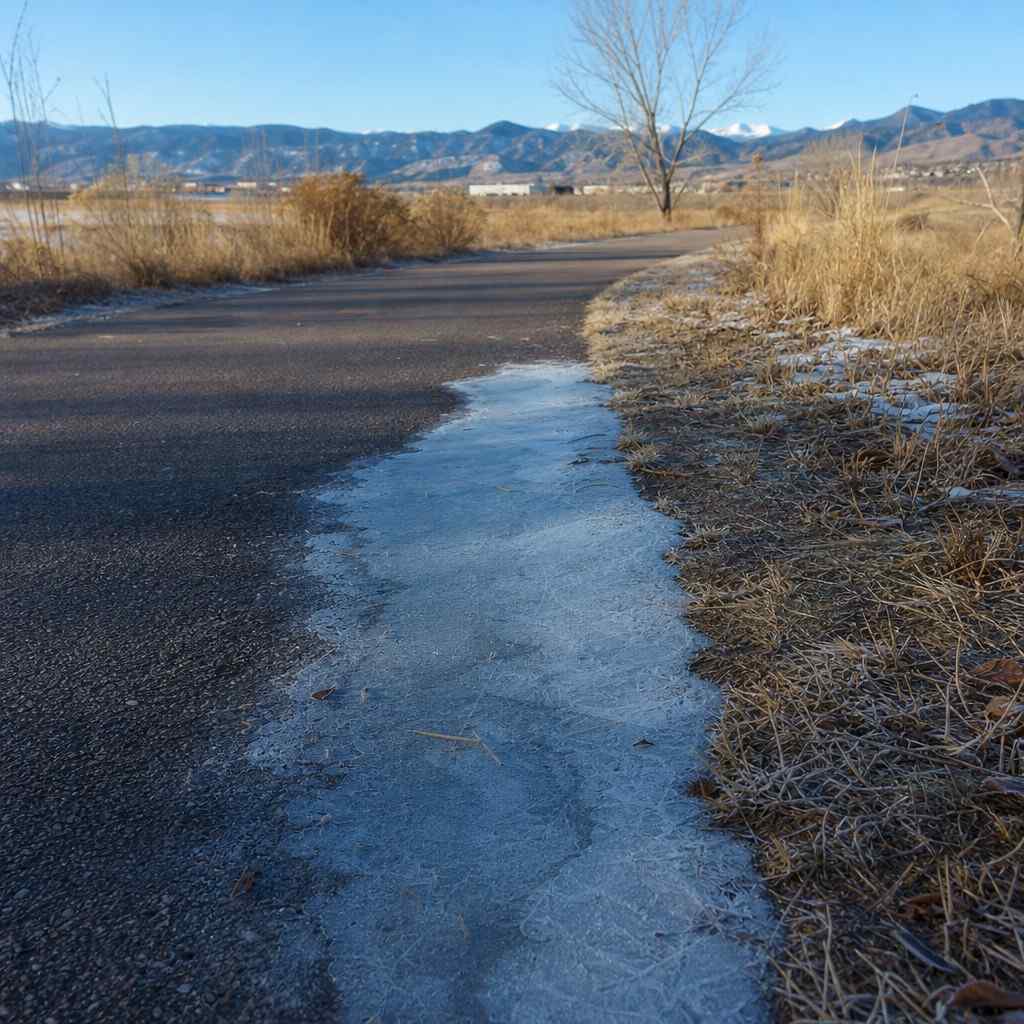
Shaded park paths and unplowed stretches hold ice for days after roads clear. South-facing trail sections melt and refreeze overnight. Corners are the high-risk spots, hiding ice patches you don’t see until you’re already on them.
Slow through any bend on a path that might be shaded. Short, controlled strides on uncertain ground. A pace that lets you stop.
This is the one condition where a treadmill is a flat-out better call. Not every cold day, not every snowy morning, but genuine black ice on your regular route is a legitimate reason to move the run inside. The treadmill is a tool, not a defeat.
Front Range weather turns fast; dress for the start line you’ll stand on, not the forecast high.
The upside nobody talks about enough
Denver is a genuinely sunny place, and that doesn’t pause for winter.
After a storm, a clear cold morning with dry air and visible foothills on the horizon is a genuinely good run. The cold keeps you from overheating. The sky is sharp. The paths are often empty.
Winter here is not months of slogging through grey slush. It’s a mix: cold starts, the occasional ice day, and a real number of mornings where you’re happy you went out.
You still dehydrate, maybe more
The dry air is easy to underestimate in winter because you don’t feel sweat the same way. But cold dry air pulls moisture out through every breath, and at altitude you’re breathing harder than you would at sea level.
- Drink water before you head out, even if you don’t feel thirsty.
- Carry water or plan a route near a fountain for anything over an hour.
- Watch for headaches or unusual fatigue after runs. Both are reliable signs you went out underhydrated.
This is the same principle that applies in summer, just less obvious. Denver’s altitude changes how every race feels; pace by effort, not your sea-level numbers, and the same environment that changes your pace also dries you out faster than you expect.
What to do with race-day cold
If you’re training through the winter toward a spring race, some of your long runs will happen in genuine cold. That’s fine and useful. You’ll know your gear, you’ll know how your body handles it, and you’ll know how to ease into the first mile.
Cold-weather racing has its own gear logic and its own rhythm, and going into it having trained outside rather than sheltering on a treadmill all winter gives you an honest read on where you are. The Christmas Carol Classic 5K and 10K is one of the local cold-weather races that gives you that test before the spring calendar opens up.
The consistent-runner version of a Denver winter
- Start slow, always. Let the first mile be the warmup.
- Layer for the start, shed on the run, cover the hands and ears.
- Watch the shaded corners, slow on any icy stretch, use the treadmill on genuine ice days.
- Drink water before, consider carrying some, take the headache seriously.
- Look for the good days. There are more of them than you’d expect.
A runner who gets outside three or four days a week through December, January, and February comes out of winter in better shape than one who paused for three months. The cold is manageable if you meet it right.