
Denver summers look great on paper: low humidity, blue skies, warm mornings. And they mostly are great for running, as long as you work with the schedule the weather sets for you rather than against it.
Three things make summer running here different from anywhere else at sea level: heat that builds fast, a sun that hits harder than you expect, and afternoon thunderstorms that are not optional to wait out.
Get those three right and the summer is yours. Get them wrong and you’re either miserable, sunburned, or standing under a tree in a lightning storm.
Run early. Not “kind of early.” Actually early.
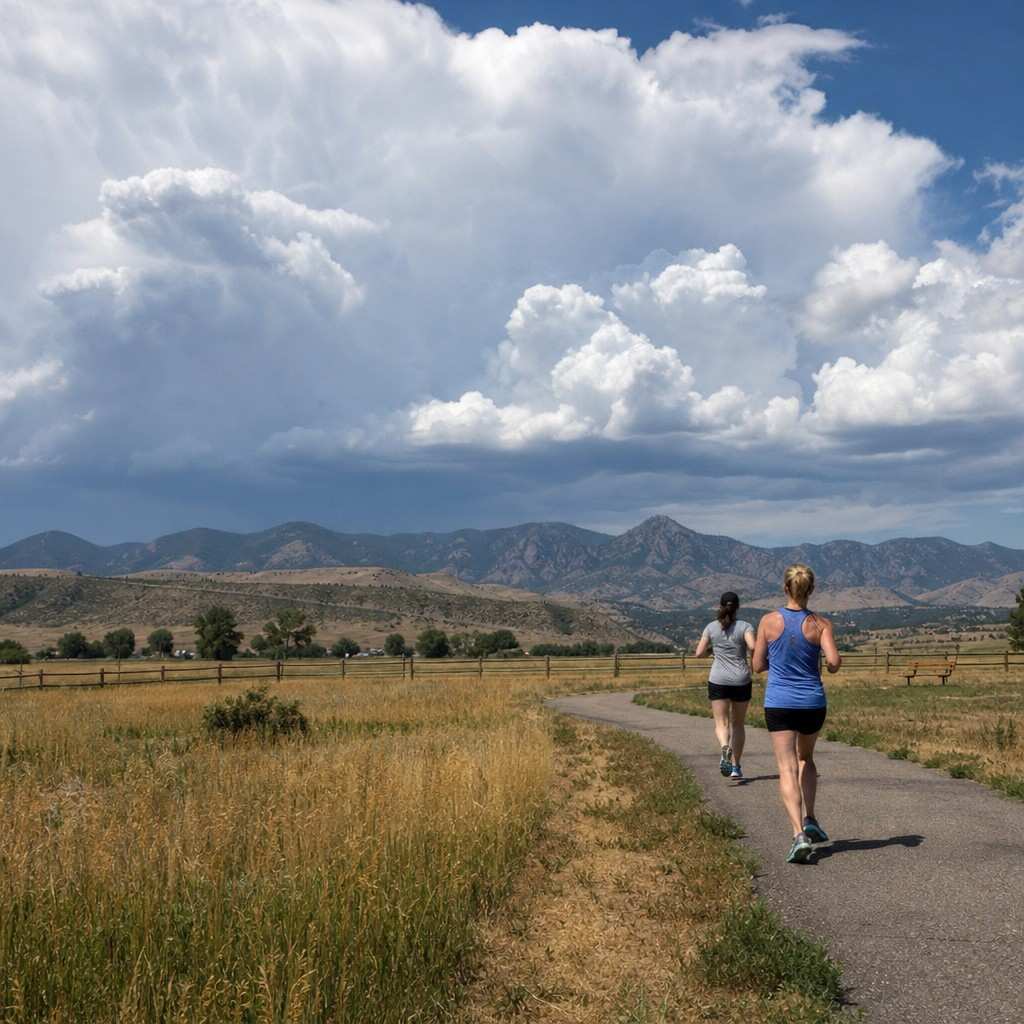
This is the one rule summer running in Denver runs on.
Mornings here are cool, calm, and genuinely pleasant, sometimes into late June. The temperature at 6 a.m. can sit 20 or more degrees below the afternoon high, and the air is still. By 10 a.m., the sun is climbing hard and the heat starts to add up. By midafternoon, storm clouds are already building over the mountains to the west.
The early window is wide and the cost of missing it is real. A 7 a.m. start on a July Saturday is a completely different run from a 10 a.m. start. Make the early one the default.
If you’re figuring out which routes work best at that hour, where to run in Denver breaks down the flat park loops, creek trails, and foothills options by what each delivers on a typical morning.
The sun here is genuinely stronger
This is not a warning to ignore because it sounds exaggerated. At Denver’s elevation, there is simply less atmosphere between you and the sun. UV radiation is meaningfully higher than at sea level, and it compounds with the summer angle.
The dry air makes it easier to underestimate how hard the sun is working on you. You’re not sweating the way you would in humid heat, so the cues that usually prompt you to slow down or take shade arrive late.
Wear sunscreen on every summer run, even short ones. A hat with a brim cuts a lot of UV exposure and keeps your core temperature lower. On longer efforts, light sleeves or a sun-blocking shirt earn their place even when the temperature says otherwise.
Front Range weather turns fast; dress for the start line you’ll stand on, not the forecast high.
That Core Principle applies to sun protection as much as cold-weather layers. The forecast high is irrelevant to a skin-deep burn that happens in the first twenty minutes.
Afternoon thunderstorms: this is not an inconvenience to run through
Almost every summer day in Denver follows the same arc. Morning is clear. By early to mid afternoon, cumulus clouds have built into towering cells over the mountains. By mid to late afternoon, lightning and rain arrive, sometimes intensely, for an hour or two before clearing out.
This pattern is consistent enough that it is reasonable to plan around it rather than hope to get lucky.
Lightning on open ground is a real danger, and the foothills and reservoir trails have nowhere to go. An open park loop in the city at least has trees, buildings, and your car nearby. A trail above treeline, a lake shore, or an exposed ridge in the foothills is a different situation entirely.
The practical rule: be done with your run, off exposed areas, and ideally back to shelter before early afternoon. On days with an early storm signal, move that earlier. A run cut short because clouds are building is the right call, not an overreaction.
Dry heat still dehydrates you
Denver’s heat doesn’t feel as brutal as humid heat. There’s no soupy air pressing down on you, and the sweat dries so fast you barely notice it. That’s the problem.
You lose water quickly in dry heat, and you lose it faster at altitude than at sea level. The thin air pulls moisture with every breath, and summer adds heat stress on top of that. The combination means your hydration needs in a Denver July are higher than they would be for the same effort and temperature at lower elevation.
Carry water on anything over 45 minutes. For longer runs, plan your route around water access or carry enough to last, because the reservoir loops and many of the longer trail segments have limited fountains. For an overview of the altitude effects behind all this, running at altitude in Denver covers the physiology in more detail.
Open and exposed routes have no shade
Some of the best summer running in Denver has one real limitation: nowhere to hide from the sun.
The open reservoir loops are fast, scenic, and bake in July. The long South Platte sections are mostly exposed. Even the park loops at Wash Park or Sloan’s Lake have limited tree cover once the sun is high.
Shade is worth routing around in the summer, and morning is when you have the most of it. The Cherry Creek Trail runs partly below street level and catches early shade well. The High Line Canal is shadier than the open trails. If you’re planning a long summer run, it’s worth checking the route’s exposure before committing.
Gear plays into this too: light-colored kit, a hat, and sunscreen are not extras here. For a full rundown on what to wear through a Denver summer run, what to wear running in Colorado covers the seasonal layering questions.
The summer pattern in short
- Run in the morning. The earlier the better, especially in July and August.
- Protect yourself from the sun. Sunscreen, a hat, and light sleeves on longer runs.
- Respect the storms. Be done and off exposed ground by early afternoon.
- Hydrate more than you think you need to. Dry heat and altitude both pull water from you faster than humid sea-level heat does.
Denver’s altitude changes how every race feels; pace by effort, not your sea-level numbers. In summer, that effort goes up faster in the heat than you’d expect, and the altitude means you have less margin than you’re used to. Adjust for both.
The summer here is genuinely good for running. You just have to meet it on its own schedule.