Colorado’s own ozone monitors put the cleanest summer air over downtown Denver, not the foothills where runners head to escape the city.
The monitor at NREL’s South Table Mountain site in Golden hit its highest 2026 reading on August 7: 97 parts per billion.
The CAMP monitor on North Broadway in central Denver has peaked lower all year, topping out at 77 ppb on July 6.
That’s a 20 ppb gap, and it runs the wrong way for anyone assuming downtown is the smoggier side of town.
The numbers come from the Colorado Department of Public Health and Environment’s 2026 ozone summary, which is still flagged as draft data for the season.
They matter most for the exact stretch when summer running in Denver already means starting early to beat the heat.
Where the ozone actually peaks this summer
The pattern holds across the whole monitor network, not just at one site. Highest single eight-hour reading recorded at each station so far in 2026:
- NREL, South Table Mountain in Golden: 97 ppb on August 7
- Rocky Flats North in Louisville: 91 ppb on August 7
- Evergreen: 88 ppb on August 7
- Chatfield Park in Littleton: 83 ppb on June 29
- Welby in Denver: 83 ppb on July 6
- La Casa in Denver: 80 ppb on July 6
- CAMP in Denver: 77 ppb on July 6
- Boulder Reservoir: 76 ppb on July 13
Every one of those readings sits above the 70 ppb level of the federal standard, and the highest numbers cluster in the foothills, not downtown.
The three-year design value, the number regulators actually use to judge attainment, tells the same story. Averaged from each monitor’s fourth-highest reading over 2024 through 2026, Rocky Flats North sits at 81 ppb and NREL at 80.
The CAMP monitor downtown averages 72, and all three sit above the 70 ppb standard.
Why the west side isn’t the clean air escape it looks like
Ground-level ozone is not emitted directly by tailpipes or smokestacks. It forms when nitrogen oxides and volatile organic compounds react in sunlight, coming from cars, power plants, and industrial sources, according to the EPA, the US government’s environment agency.
That reaction takes time and daylight, and its byproduct does not stay where it started.
Ozone can travel long distances on the wind, so even rural and outlying areas can see high levels, the EPA notes.
Colorado’s own monitor data is consistent with that.
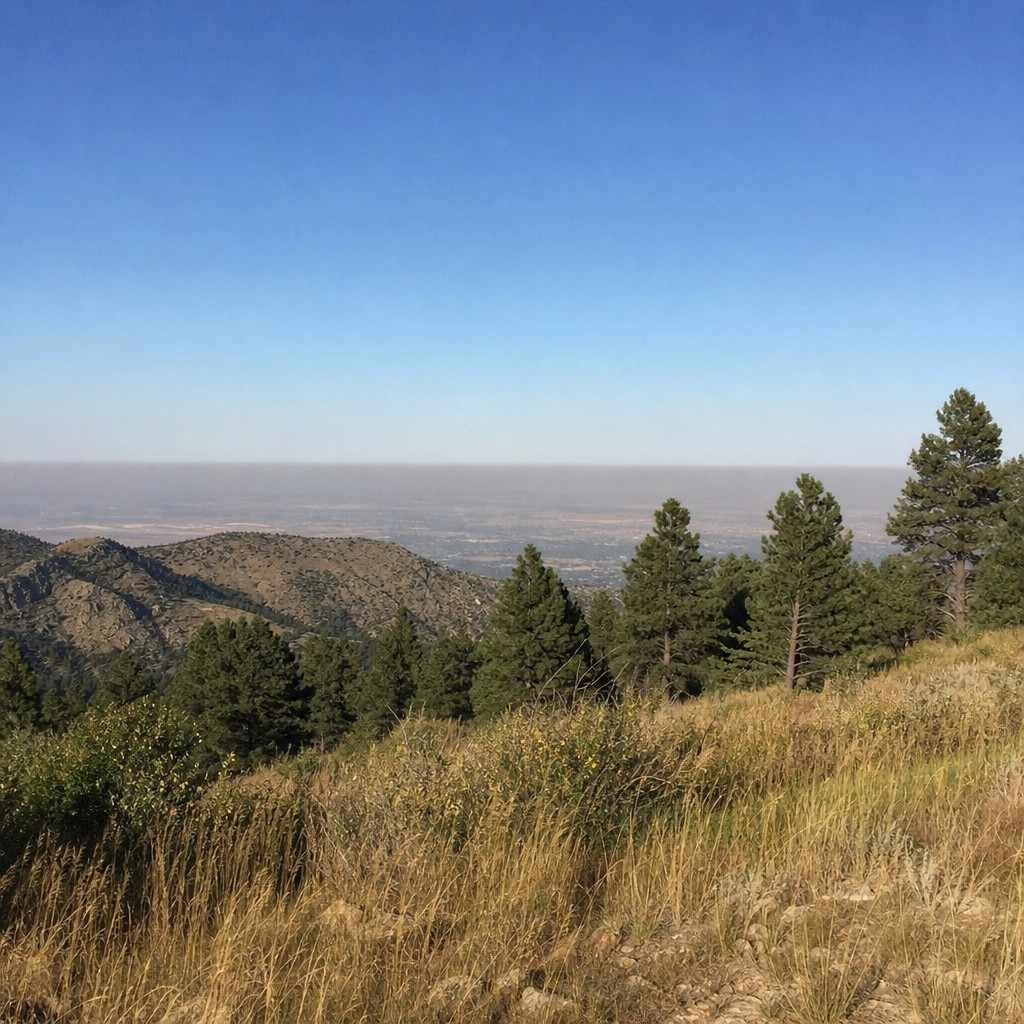
The highest 2026 readings sit in Golden and Evergreen, in the foothills west of the city.
That’s exactly where a lot of trail running near Denver happens, not on the monitors closest to downtown traffic.
There is no specific wind pattern or transport time in the state’s data to point to here, so this stays general. The pollution forms over the urban corridor during the day, and it does not necessarily stay there.
What the research says happens at a hard effort
A 2024 study in the Journal of Applied Physiology tested what higher ozone actually does to an exercising body, not just what a monitor reads.
Researchers ran a three-visit, double-blinded, randomized crossover trial on 20 aerobically trained participants, 13 men and 7 women averaging a VO2max of 64.1 mL/kg/min.
Each participant was exposed to 170 ppb ozone or clean room air, under 10 ppb, on separate visits. The study’s authors describe 170 ppb as “peak real-world levels” of exposure.
Each session followed the same shape: a 25-minute moderate warmup, a 30-minute heavy-intensity bout, then a time-to-exhaustion test.
At the time-to-exhaustion test, ozone lowered end-exercise oxygen uptake by 3.2 percent, plus minute ventilation and tidal volume.
During the moderate, submaximal part of the workout, the researchers found no differences in oxygen uptake or ventilation between the two conditions. The effect was not there yet.
It showed up at the hard end.
At the time-to-exhaustion test, ozone lowered end-exercise oxygen uptake by 3.2 percent, plus minute ventilation and tidal volume. Exercise duration was 10.8 percent shorter under ozone, but that difference did not reach statistical significance.
That is a trend, not a proven finding, and the study’s own authors say so. They describe the pattern as a likely combined effect of pollution dose and exercise intensity together.
Exercise duration was 10.8 percent shorter under ozone, but that difference did not reach statistical significance.
Two honest limits belong right next to that finding. This was a cycling test, not a running one, in twenty well-trained adults.
And 170 ppb sits well above the 97 ppb Colorado’s monitors recorded at their worst so far this year.
What ozone does to a runner’s airways
The EPA names people who are active outdoors as an explicit risk group for ozone, alongside people with asthma, children, and older adults. That is not incidental to a Denver runner.
Breathing harder means moving more air, more often, past airway tissue that ozone can irritate.
Ozone is a powerful oxidant that can irritate the airways, in the EPA’s own description.
It can cause the muscles in the airways to constrict, trapping air and producing wheezing and shortness of breath.
Depending on how much and how long the exposure runs, ozone can also:
- cause coughing and a sore or scratchy throat
- make it harder to breathe deeply and vigorously
- cause pain on a deep breath
- inflame and damage the airway lining
- make the lungs more susceptible to infection
Some of these effects turn up even in healthy people, not only in runners with asthma or another lung condition. It is a dose-and-effort relationship.
Harder breathing pulls in more ozone, which is exactly what a hard training session or a race asks of you.
None of this is a diagnosis.
If breathing feels different on a high-ozone day, that’s information worth passing along to a doctor, especially if it keeps happening.
The advisory, the season, and why it isn’t just a Denver problem
Colorado’s own guidance during Ozone Action Alerts is direct: avoid rigorous outdoor activity during the heat of the day. The state’s daily forecast generally advises reducing prolonged or heavy outdoor exertion from noon to 8 p.m.
The official tracking window for Ozone Action Day alerts runs May 31 through August 31. It covers the whole Front Range Urban Corridor, from Douglas County north through Larimer and Weld, including the Denver-Boulder area, Fort Collins, and Greeley.
Front Range weather turns fast; dress for the start line you’ll stand on, not the forecast high.
A cool morning can turn into a hot afternoon fast.
Colorado’s own guidance during Ozone Action Alerts is direct: avoid rigorous outdoor activity during the heat of the day.
That swing is part of why the exertion window matters as much as the calendar date.
This is not a one-summer issue. The EPA classifies the Denver Metro/North Front Range area Severe nonattainment for the older ozone standard and Serious for the newer one.
Both deadlines land in 2027, and that is regulatory language for a problem expected to stick around, not a single bad season.
None of this replaces the fundamentals, either.
It is worth revisiting effort-based pacing at altitude before a hard summer session. Heat, thin air, and now air quality can all blunt the same workout for different reasons.
Before your next hard session in ozone season
The data points to a short set of practical adjustments, not a reason to skip summer training.
- Check the day’s ozone advisory before a hard effort, not after you are already out the door. The alert season runs May 31 through August 31.
- Save the hardest work for outside the noon-to-8-p.m. exertion window the state advises whenever an alert is active.
- Treat a foothills trail run as an air quality decision, not just a scenery one. Colorado’s own monitors have read higher in Golden and Evergreen than downtown all year.
- Put intervals, tempo work, and time trials on the cleanest air day available. The research effect shows up at maximal effort, not at an easy pace.
- Do not assume a cool morning means clean air. Ozone can travel long distances on the wind, and temperature alone does not tell you what a monitor would read, so check the advisory instead of the thermometer.
- Treat wheezing, chest tightness, or unusually hard breathing as a stop signal, especially with asthma or another lung condition. The EPA lists people who are active outdoors among those most at risk.
This is general information, not medical advice. If you have asthma or another lung condition, talk to your doctor about what air quality levels mean for your training.