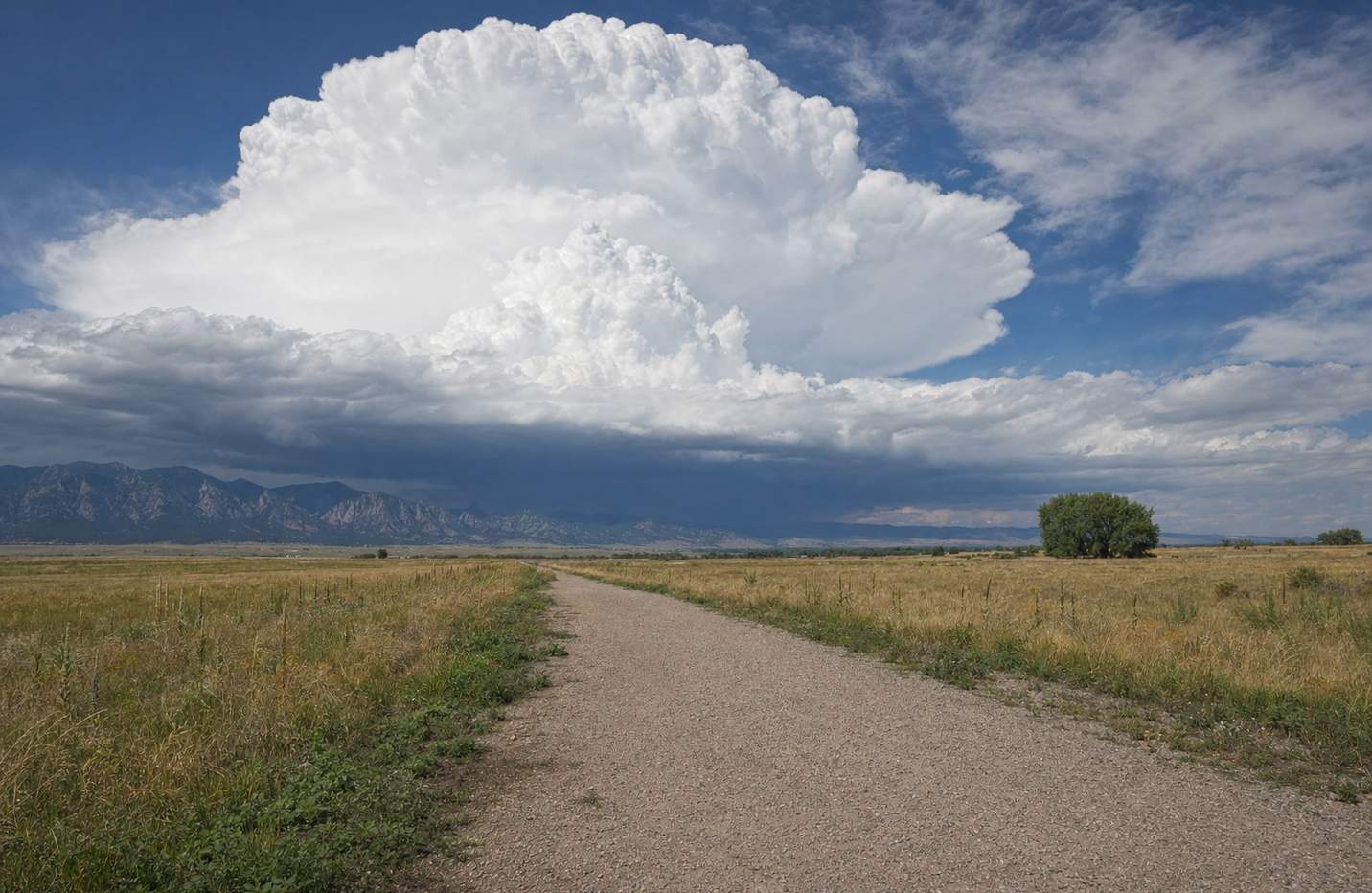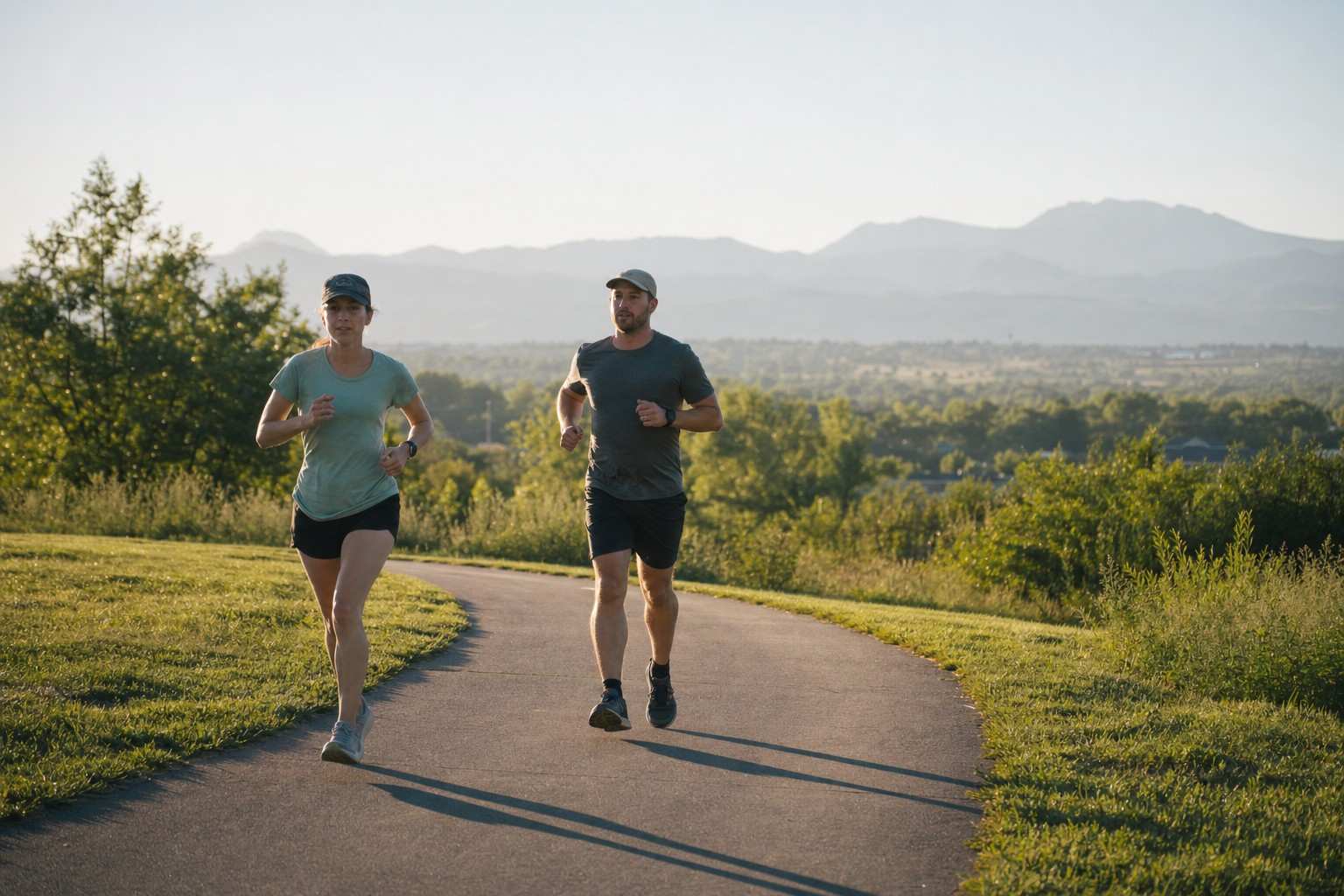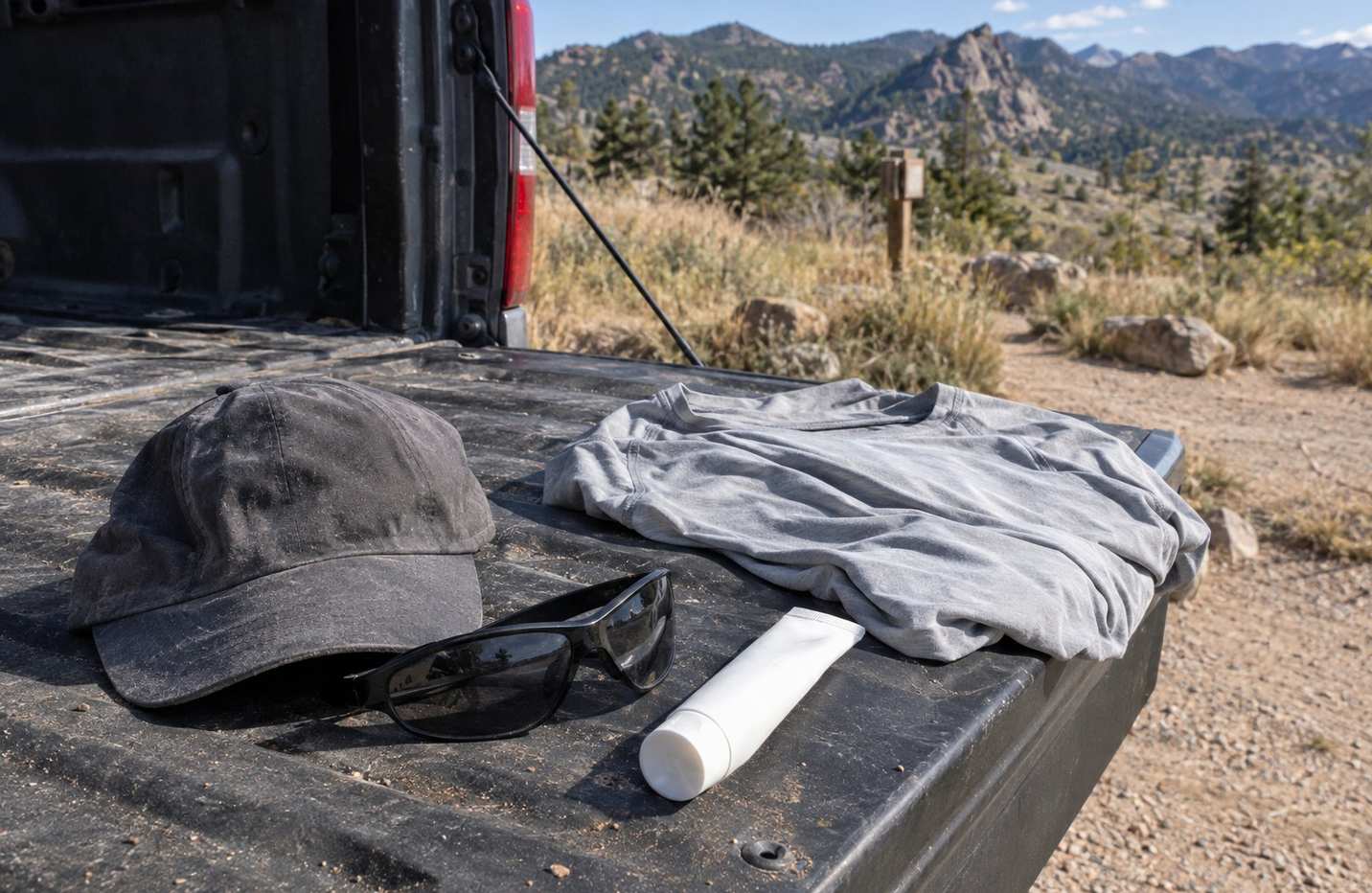
Pick a Saturday in late July on a reservoir loop east of Denver. The path runs open for long stretches, and there’s nowhere to duck out of the sun.
By mile three your neck is pink and your eyes are tired from squinting. None of that is about the mountains behind you. The fix is what you didn’t put on before you left the house.
The Front Range doesn’t hide the sun the way tree cover does back east. Most popular routes here run open and exposed for long stretches.
Altitude asks you to be patient with your pace. Sun protection asks for nothing of the kind: it is a short list of gear, worn the same way on every run.
The list below starts with the number that matters most.
Check the number, not the season
The World Health Organization and NOAA, the US federal ocean and atmosphere agency, publish different coefficients for this.
Applied to Denver’s elevation they give the two ends of one range, roughly 10 to 16 percent more UV than a sea-level run.
UV doesn’t wait for a clear sky, so the habit matters more than checking the forecast for sun.
The UV Index from the EPA, the US federal environment regulator, gives runners a simpler trigger than the elevation math. At 1 to 2, no protection is needed.
From 3 to 7, protection is needed, especially in late morning through mid-afternoon. At 8 and up, the same window calls for extra protection.
Check tomorrow’s UV Index the same time you check the temperature. If it’s 3 or higher, treat that as your packing list, not just today’s high or low.
What actually helps at altitude
Five things do most of the work here, roughly in the order they matter for a Front Range runner. The order below runs from cheapest and most effective to smallest and easiest to forget.
Sunburn on a run is a packing failure, not bad luck.
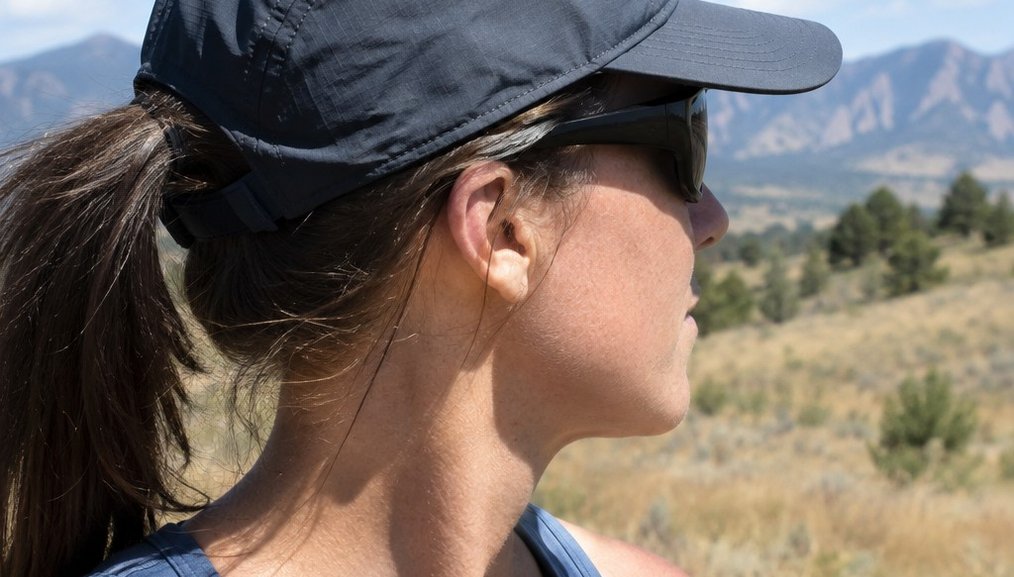
A cap or visor with a brim is the cheapest fix here, and it does the most work. It shades your face and scalp, the spots that burn first. Sunscreen wears off fastest there too, once sweat gets going.
A neck flap or a bandana tucked under the back adds coverage for a bald spot or a fresh haircut. It packs small enough to carry even when you don’t expect to need it.
If you need one, the Headsweats Reflective Race Hat has a ponytail opening.
 Headsweats Reflective Race Hat
Ponytail opening, adjustable buckle
Dark undervisor, reflective piping
Open the listing on Amazon
This article includes Amazon links. Feat on the Street earns a small commission on anything bought through them, and the full affiliate disclosure explains how that works.
- Running sunglasses matter more than most runners give them credit for. Your eyes and eyelids are exposed skin too, and squinting through an hour of glare adds its own fatigue. Wraparound styles cut glare off pavement and off water, which matters on a reservoir loop with sun bouncing from two directions at once. Fit is the running-specific problem here, not price. A dark lens is not the same thing as a UV-blocking lens. Check the tag or the listing rather than assuming a tinted pair blocks UV. A pair that slides at mile four is no use. The Tifosi Track is one built for that: nose pads that grip harder as you sweat, and lenses Tifosi lists as blocking 100% of UVA and UVB.
- Sport sunscreen is worth choosing over a basic bottle. The difference that matters for running isn’t the SPF number. It’s whether the formula stays put once you start sweating. On a run over about ninety minutes, carry a small tube and reapply once, the habit that keeps it working through a long day outside. If yours rubs off by the first mile, Coppertone Sport SPF 50 is labeled water resistant for 80 minutes.
- A UPF long-sleeve is worth it for a reason beyond sun. It doubles as the shoulder-season layer covered in dressing for a Front Range morning, so it earns its cost twice. It’s especially useful above treeline too, where a trail run loses cover for miles and the sun has nothing in the way. If you don’t have one yet, the Brooks Luxe Long Sleeve carries a UPF 50+ rating and thumbholes, in men’s and women’s cuts.
 Tifosi Track Sunglasses
Lenses block 100% of UVA and UVB
Nose pads that grip as you sweat
Open the listing on Amazon
 Coppertone Sport Sunscreen Lotion SPF 50
Water resistant for 80 minutes
Free of oxybenzone and octinoxate
Open the listing on Amazon
 Brooks Luxe Long Sleeve Running Shirt
UPF 50+ fabric
Thumbholes, semi-fitted cut
Open the listing on Amazon
Men's
Women's
None of this needs to cost much.
It shades your face and scalp, the spots that burn first. Sunscreen wears off fastest there too, once sweat gets going.
Lip balm with SPF is small enough to forget and easy to lose. The lower lip is thin skin facing straight up, and it’s a genuine site for skin cancer.
Reapply it at the same time as sunscreen, since the lower lip gets skipped more than any other spot on a runner’s face.
Toss one in a pocket or a hydration vest and keep a spare there. A small stick such as Sun Bum SPF 30 Lip Balm fits the smallest pocket.
 Sun Bum SPF 30 Lip Balm
Broad spectrum SPF 30
Small stick for a pocket or vest
Open the listing on Amazon
What you don’t need to buy
What you carry should match the hour you are actually out, not the day’s average. Front Range mornings and afternoons are two different exposures.
None of this is complicated.
There’s no such thing as an altitude-specific sunscreen. Nothing here needs adjusting for elevation.
The UV Index on your weather app already includes Denver’s elevation as one of its inputs. The forecast has done that math for you. Adding your own altitude adjustment on top just counts the same thing twice.
A very expensive pair of sunglasses doesn’t protect better than an inexpensive pair that blocks UV. Fit and staying put through a sweaty mile are the real running problems, not the price tag.
The UV Index on your weather app already includes Denver’s elevation as one of its inputs.
A cheap pair that blocks UV protects your eyes just as well as an expensive one.
A high SPF number isn’t a proportional gain, and reapplying matters more than the number on the bottle. No single threshold is right for every skin type or every run, so this page won’t invent one.
Reapplying every couple of hours does more than chasing a bigger number ever will.
A changing mole, or a personal history of skin cancer, is worth a dermatologist’s opinion before it’s worth a gear list.
If you run before about 8 a.m. through a Denver winter, most of this matters much less. The sun angle stays low, the same logic behind early miles through a Colorado winter.
Days are short, the sun sits low even at noon, and most winter runs happen well outside the window that matters.
That’s the whole list of exceptions.
The UV Index on your weather app already includes Denver’s elevation as one of its inputs. The forecast has done that math for you.
None of that is an argument against sun protection. It’s an argument against overpaying for something ordinary gear already covers.
Start with the cap
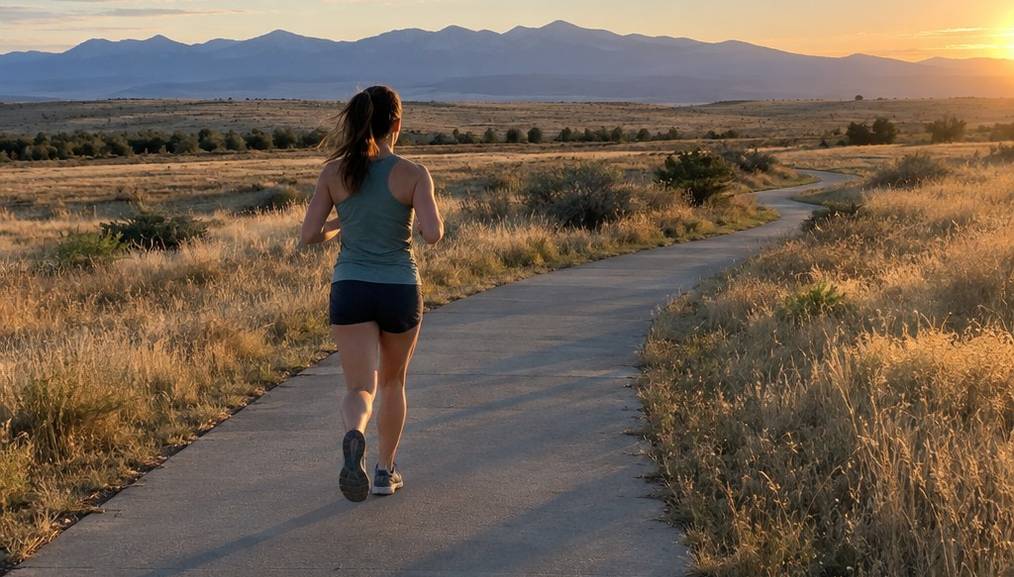
If you buy exactly one thing from this list, make it the cap. It’s the cheapest item here, and it works on every kind of run, sun or shade.
The sunglasses and the sunscreen matter too, and most runners already own a version of both.
Set it by the door tonight, so tomorrow’s run starts with it already on, not remembered halfway around the loop.