The first rule of a Denver summer is to run early. Ozone builds through a hot afternoon, so the morning is the cleaner side of the day.
The second rule arrives with wildfire smoke, and it is not about the clock: when there is smoke in the air, limit outdoor activity.
On a smoke morning, the run-early rule can walk you straight into the dirtiest air of the day.
Both come from one federal guidance document for schools, written by the Environmental Protection Agency and the Centers for Disease Control and Prevention.
It says to plan around ozone in the morning.
Particle pollution, the kind wildfire smoke is made of, gets no safe hour at all.
The reason is in the atmosphere. The evidence is in Colorado’s own emergency department records.
The fix is two levers and a daily check.
What the air does overnight
Ozone is a pollutant with a schedule. According to the guidance for schools from the EPA and the CDC, the US federal environment and public health agencies, it is often worse on hot sunny days, especially in the afternoon and early evening.
That’s where the run-early rule comes from. It’s the right call for ozone season in Denver, and smoke doesn’t cancel it.
Wildfire smoke is a different pollutant, and it doesn’t keep ozone’s schedule.
It is particle pollution, PM2.5, fine particles 2.5 micrometers across and smaller. The same document says particle pollution can be high any time of day, and that smoke in the air means limiting outdoor activity.
The reason the clock fails is what the atmosphere does after dark.
Through a hot day the lower atmosphere stays well mixed, and smoke can ride high above the ground. After sunset the mixing layer collapses, and smoke that sat aloft all day settles into the air near the surface.
Smoke can be high at any hour, and some smoke days stay bad from dawn to dusk.
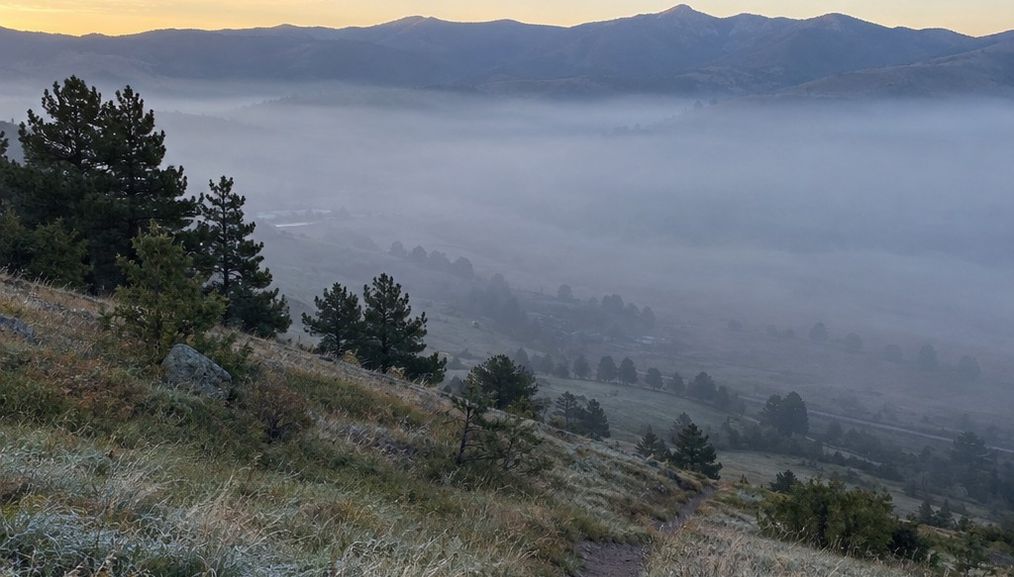
Cool air drains downhill after dark and carries smoke down with it, into valleys and low spots. The state’s own Colorado Smoke Blog routinely describes this pattern: smoke settling into valleys overnight.
The blog’s routine advice on smoke days is direct: smoke is mostly a morning problem, so limit time outdoors in the morning.
The early run is an ozone tactic. On a smoke morning it can be the worst hour of the day to be outside.
This does not swap a morning rule for an evening rule. Smoke can be high at any hour, and some smoke days stay bad from dawn to dusk.
After sunset the mixing layer collapses, and smoke that sat aloft all day settles into the air near the surface.
The check comes before the clock
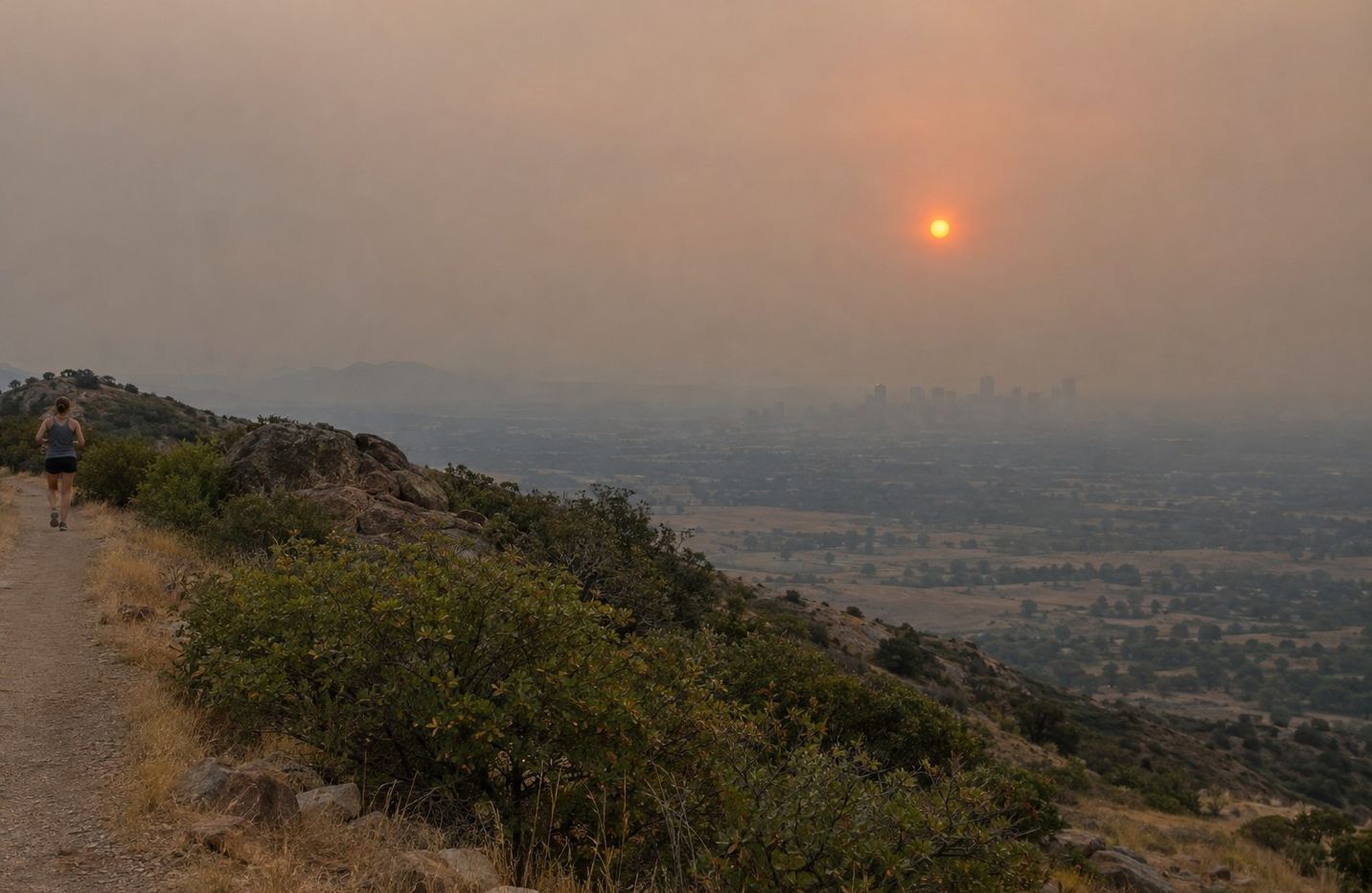
A smoke morning on the Front Range can look like almost nothing. A pale sun comes up over the plains, the foothills sit behind a gray-brown haze, and nothing about it says emergency.
The eyes are the wrong instrument.
Colorado’s health department makes the point on its wildfire smoke page: you do not need to see or smell smoke for it to affect you.
The same page names anyone exercising outdoors among the people at greater risk. Its advice is to limit strenuous or extensive outdoor activity while smoke is present.
What the sky looks like tells you nothing. The monitor tells you what the air is.
So the check happens before the run, not during it.
Two resources cover it:
- AirNow gives the number. The Environmental Protection Agency’s Air Quality Index, or AQI, has six bands, and the AQI basics page explains each one.
- The Colorado Smoke Blog gives the reason. It posts which fires are feeding the smoke, which counties are affected, and a 24 to 48 hour forecast for where it goes.
- Read them together. The AQI says how bad today is; the outlook says why, and whether tomorrow is better.
Shorten it, slow it, or move it
The EPA and CDC document names exactly two fixes for smoke, and both are things a runner controls.
Spend less time breathing hard, and breathe less hard while you do it.
The reason is mechanical. More pollution enters the lungs when a person is breathing harder, the document says, and running is breathing hard on purpose.
On a smoke day the two levers are duration and intensity: a shorter run, or an easier one.
Walk instead of run is the document’s own example of lowering the intensity. Front Range runners already know this skill; pacing by effort at altitude teaches it for thin air.
How much to adjust depends on the AQI band. Below 51 is the Good band, where AirNow says air pollution poses little or no risk, and there is no decision to make.
| AQI band | What the EPA and CDC activity guidance says |
|---|---|
| Moderate, 51 to 100 | It’s OK to be active outside. For longer or more intense efforts, take more breaks and do less intense activities. |
| Unhealthy for Sensitive Groups, 101 to 150 | Take more breaks and do less intense activities for all outdoor activity. Consider moving longer or more intense activities indoors or rescheduling them. |
| Unhealthy, 151 to 200 | Move all activities indoors or reschedule them to another day. |
The scale keeps going. At 201 and above, AirNow’s language shifts to a health alert for everyone, and at 301 and up, emergency conditions. No runner needs a table for those mornings.
One honest limit: the table was written for schoolchildren. The document says children are more sensitive to air pollution than adults, and it was not written for adult runners. It is still the most concrete published activity-by-AQI table.
A runner with asthma or another lung condition has a sharper version of this decision. A smoke day is exactly when to use the action plan written with your own clinician, not a running article’s judgment.
What Colorado’s own records show
The health case is measured, not assumed. Researchers examined 446,106 emergency department health events among Colorado residents in a study of wildfire smoke and cardiorespiratory events, May through August, 2011 to 2014.
The design compares each patient’s smoke days with the same patient’s non-smoke days nearby, so the study shows association, not proof of cause.
Three results, and the third is the one worth knowing.
- Asthma is the clearest finding. Emergency visits for asthma ran about 8 percent higher on smoke days. Both children and adults showed it; for older adults it was not significant.
- Combined respiratory disease rose about 2 percent, a smaller but still significant association.
- Cardiovascular events did not move. The study found no significant association between smoke days and emergency visits for cardiovascular disease, in any age group.
That null matters as much as the finding. The case for adjusting a run is real, and it is a lung case, not a heart case, in this data.
One more detail sharpens the picture. Non-smoke particle pollution showed no association with any outcome. Where there was an effect, it belonged to smoke, not to ordinary dirty air.
Smoke season on the training calendar
None of this means running less through a Front Range summer.
It means the clock stops being the deciding factor on smoke days.
Pick a race by the season and the scene, not just the distance. The Colorado data measured smoke season as May through August. A summer goal race carries that risk, and a late-fall one sits outside the study’s window.
The early start that summer running in Denver leans on still beats the afternoon heat. It also clears the hours where lightning in Denver concentrates its casualties.
The run-early rule survives smoke season. It just stops being automatic.
- Put the workout where the week’s cleanest air is. The Smoke Blog’s 24 to 48 hour forecast makes that a real decision, not a guess.
- Keep easy days genuinely easy. Breathing hard is the specific thing smoke guidance tells you to limit, and an easy pace is the simplest way to do it.
- Have an indoor option you will actually use. When the AQI reaches Unhealthy, the guidance says to move indoors or pick another day, and both are easier with a plan.
Before a smoke-season run, check the AirNow AQI and the Colorado Smoke Blog, and let them tell you when to go.